The 20-Minute Problem Nobody's Solving
December 29, 2025 • By Zak Winnick
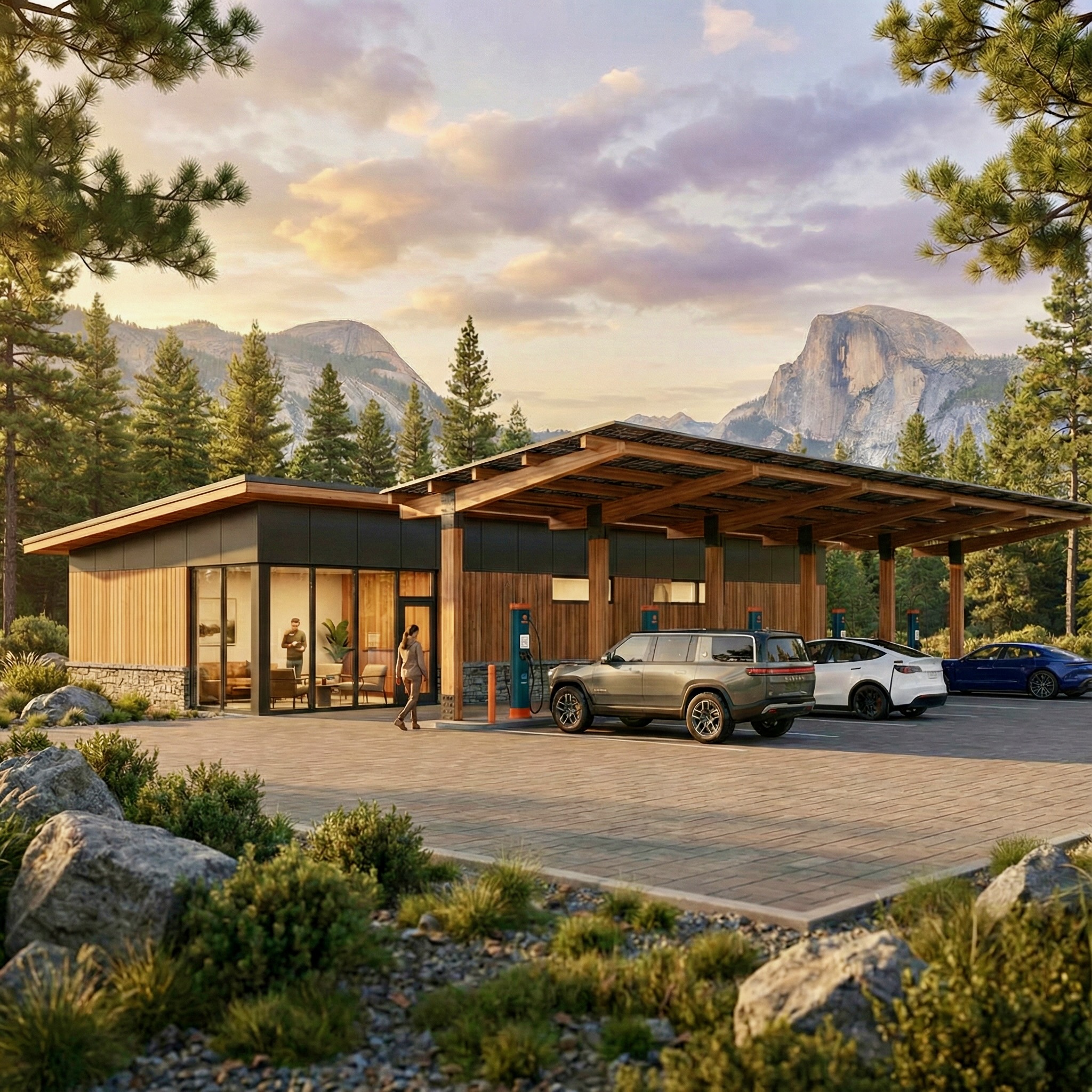
A recent Bloomberg feature dubbed America’s national parks the “final EV frontier” for charging infrastructure. The numbers tell the story: 332 million park visitors last year, roughly 100 charging stations across all 63 parks, and only 12 of the 20 largest parks offering any charging at all.
The industry response has been predictable. More chargers in more places. Better grid connections. Faster deployment.
All necessary. All missing the point.
The Places People Want to Go
Parks earn the “frontier” label because they’re hard to serve. Remote locations. Limited grid infrastructure. Seasonal visitation that complicates the economics. Building in pristine, remote areas is far tougher than installing chargers along highways.
But consider what this framing implies.
The charging industry prioritizes locations based on ease of deployment and utilization math. Grid access. Traffic counts. Throughput potential. The result is chargers concentrated where they’re easiest to build, not necessarily where people most want to travel.
This tension exists everywhere. The routes people dream about driving rarely align with the routes that make sense on a spreadsheet. Coastal highways. Mountain passes. Desert crossings. The drives that justify owning a vehicle capable of adventure are frequently the drives with the least infrastructure support.
The industry sees this as a sequencing problem: build the easy stuff first, tackle the hard stuff later. But “later” keeps getting pushed back, because there’s always more easy stuff to build.
Who Built This Industry
Listen to how charging network executives talk about their work. Deployment speed. Grid connections. Utilization rates. This is the language of utilities and infrastructure developers.
That’s because automakers, energy companies, and infrastructure developers built this industry. Tesla built Superchargers to sell cars. Utilities built chargers to sell electricity. Infrastructure funds built chargers to deploy capital. Each had legitimate business reasons, but none came from a background where experience design was core to the business.
This shapes everything. When your mental model is “deploy infrastructure,” you optimize for coverage and uptime. You measure success in charger counts and kilowatt-hours delivered. The human experience becomes secondary, something to address after the core infrastructure problem is solved.
Hospitality works differently. When your mental model is “take care of guests,” you start with the human experience and work backward to operations. You measure success in satisfaction and repeat visits. Infrastructure becomes a means to an end rather than the end itself.
The industry discusses charging gaps as logistics challenges. Nobody asks what it would feel like to stop there, or whether “stopping” is even the right frame.
The Road Trip Reality
National parks are destinations. But EV drivers don’t teleport to Yellowstone or Yosemite. They drive hundreds of miles to reach them. The park charging gap matters, but the corridor experience matters more, because that’s where drivers spend the bulk of their travel time.
Those corridors are where the industry has focused. Highway-adjacent locations with good grid access and high traffic counts. By the numbers, this makes sense. In practice, it’s produced an endless repetition of the same experience: parking lots with chargers, adjacent to whatever retail happens to be nearby.
Anyone who has done these drives knows the routine. Pull off at a charging location. Assess your options. Maybe there’s fast food. Maybe there’s a big-box store. Maybe there’s nothing but chargers and a view of the highway. Plug in, then figure out how to kill 20 to 30 minutes in a place that wasn’t designed for you to spend 20 to 30 minutes.
This is EV road tripping in 2025. Not range anxiety, which network expansion has largely solved. Experience anxiety. The nagging question of what you’ll find when you arrive and whether it will be worth stopping.
What Hospitality Thinking Would Change
In hospitality, there’s a concept called the “guest journey.” It maps every touchpoint from initial awareness through post-visit follow-up. Each interaction should reinforce the brand promise and move the guest toward satisfaction and loyalty.
The charging industry has no equivalent. Each session is treated as an isolated transaction. Plug in, charge, pay, leave. Whatever happens during those 20 to 30 minutes falls outside the scope of service.
This is a choice, even if it doesn’t feel like one. The industry defined its product as electricity delivery rather than travel support. That definition shapes everything downstream: what gets measured, what gets invested in, what gets optimized.
At Rangeway, we define our product differently. We’re not in the electricity delivery business. We’re in the business of making long-distance EV travel feel effortless and enjoyable. Electricity is a component, but so is comfort, reliability, and the overall experience of stopping.
This is why we guarantee climate-controlled indoor space at every location. Not as a nice amenity, but as the foundation of the experience we’re designing. You can’t take care of guests standing in a parking lot in 105-degree heat or 25-degree cold. The indoor space isn’t an add-on. It’s the starting point.
We think about the full journey, not just the individual stop. What does the driver need before arriving? Clear information. Confidence the chargers will work. Knowledge they’ll have a comfortable place to wait. During the stop? Climate control. Clean restrooms. Decent food and coffee. A place to stretch and decompress. After? A sense that the stop was worth making, that it added to the trip rather than detracting from it.
This is basic hospitality thinking. It’s just never been applied to charging.
The Real Frontier
The real frontier isn’t geographic. It’s experiential.
We don’t just need chargers in more places. We need better experiences at the places we charge. The industry has been so focused on closing coverage gaps that it’s neglected the experience gaps at locations already built.
The 20-minute charging window isn’t going away. Physics won’t allow it. That time will either be spent in places designed around driver comfort or places designed around charger throughput.
Right now, the industry chooses throughput. More chargers, more locations, more kilowatt-hours delivered. The assumption is that experience will follow once coverage is solved.
We don’t think that’s right. Experience and coverage need to develop together, because the habits being formed now will persist. Drivers who learn that charging stops are something to endure will carry that expectation forward. Drivers who discover that charging stops can be genuinely pleasant will become advocates for the technology.
Better days won’t arrive just because more chargers get built. They’ll arrive when someone decides that the 20 minutes matter as much as the electricity.
That’s what we’re building. Not just chargers in better places, but better places to charge.
Recent Posts
Infrastructure Isn't SaaS: What Nobody Tells Founders About Building Physical Things
I was listening to the most recent episode of The eMobility Marketing Podcast where Theo Reichgelt sat down with Philip Meyer of Lazy Growth Partners to talk about building B2B...
Read moreThe EV charging experience is getting better. We think that's not enough.
Credit where it’s due: the industry is waking up. Comfortable lounges. Clean restrooms. Better lighting. Real amenities. Some operators are doing genuinely good work making the charging stop more pleasant....
Read moreThe State of EV Charging in 2025: Quality Is Finally Winning
The numbers are in. Paren’s Q4 2025 State of the Industry Report confirms what the data has been showing for years: EV charging infrastructure is growing fast, but quality is...
Read more