Charging is Now a Hospitality Problem, Not a Utility Problem
December 01, 2025 • By Zak Winnick
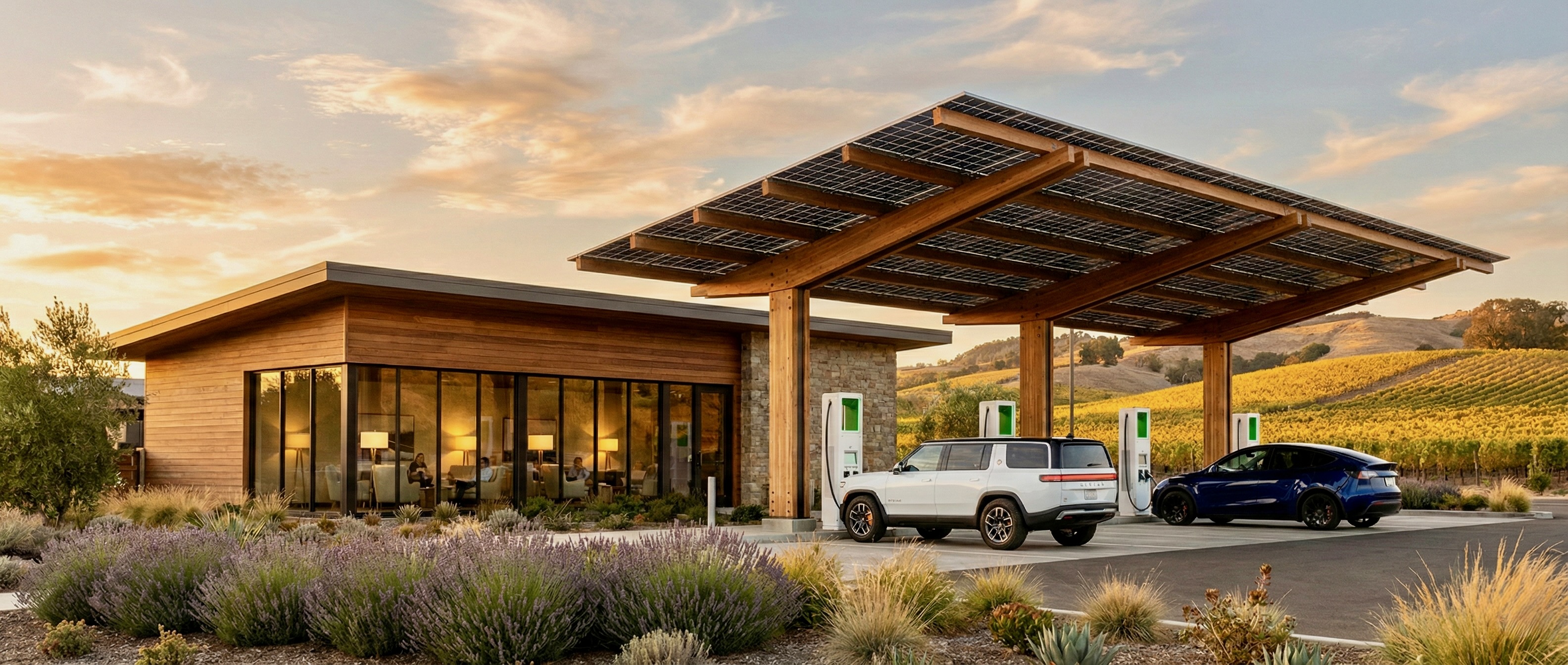
For years, the EV charging industry operated with a simple playbook: deploy chargers, move on, repeat. The thinking was that drivers just needed electricity, and everything else was a nice-to-have. Site selection was about grid capacity and traffic counts, not about creating places where people would actually want to spend time.
That era is ending. The networks that don’t recognize this shift are going to find themselves competing purely on price in a commodity market with razor-thin margins.
Why Now?
The EV buyer has fundamentally changed.
Early adopters were willing to tolerate almost anything to drive electric. They’d wait in parking lots, hunt for working chargers, troubleshoot error codes, and make do with whatever facilities happened to be nearby (if any existed at all). These were enthusiasts who saw themselves as pioneers, willing to sacrifice convenience for the privilege of being first.
But as EVs go mainstream, the new wave of buyers aren’t enthusiasts willing to suffer for the cause. They’re people who chose an EV because it was the best vehicle for their needs, not because they wanted to join a movement. They expect infrastructure quality to match their vehicle investment. They expect the charging experience to be at least as good as the gas station experience they left behind, and ideally much better.
This isn’t an unreasonable expectation. It’s the baseline expectation for every other premium purchase they make. Yet the charging industry has largely failed to meet it.
The Expectation Shift
Here’s something I think about constantly: when someone buys a premium vehicle, they expect premium experiences everywhere that vehicle takes them.
Hotels understood this decades ago. The entire hospitality industry is built on the insight that how you treat guests during their stay determines whether they come back and what they tell others. Airlines figured it out, creating tiered experiences that reward loyalty with comfort and recognition. Restaurants get it. Retail gets it. Even gas stations have evolved, with brands like Buc-ee’s turning fuel stops into destinations.
Yet charging networks have largely ignored this reality.
The standard model treats every driver the same way: here’s a cable, here’s a parking spot, good luck finding a restroom. Maybe there’s a convenience store nearby. Maybe not. Maybe it’s open. Maybe the bathroom requires a purchase or a code or is simply out of order. Every stop is a gamble.
The disconnect is jarring. Someone drives a beautifully designed EV with a premium interior, advanced technology, and thoughtful details everywhere you look. Then they pull into a charging station and stand in a parking lot for 30 minutes with nowhere to sit, no shelter from weather, and facilities that would embarrass a highway rest stop from the 1970s.
This isn’t just uncomfortable. It’s a failure of imagination. The industry has been solving a utility problem when it’s actually a hospitality problem.
Think about what we’re asking people to do. We’re asking them to spend 20 to 40 minutes at a location while their vehicle charges. That’s not a transaction. That’s a stay. Yet we’ve designed these stays as if the human being attached to the vehicle doesn’t exist, as if the only customer is the car itself.
The Customer Expectation Gap
I’ve spent over 15 years in hospitality, from properties like Wynn Las Vegas and the Cosmopolitan of Las Vegas to boutique wellness retreats. In hospitality, we obsess over guest experience at every touchpoint. We think about arrival, about first impressions, about comfort during the stay, about departure. We design spaces that make people feel welcome and cared for.
The charging industry has done almost none of this work.
Instead, the focus has been on deployment speed, on hitting charger count targets, on geographic coverage maps that look impressive in investor presentations. These metrics matter for infrastructure, but they miss the point for hospitality. A network with 10,000 chargers where drivers have a mediocre experience at each one isn’t better than a network with 1,000 chargers where drivers genuinely enjoy their stops.
The gap between what premium EV drivers expect and what the industry delivers is enormous. That gap represents both a problem and an opportunity.
The Competitive Reality
Here’s the business case for hospitality that I think too many operators miss: commodity charging is a race to the bottom.
When every network offers the same parking lot experience, the only differentiator becomes price. Drivers open their app, see which station is cheapest, and go there. There’s no loyalty, no preference, no reason to choose one network over another beyond the number on the screen.
That’s a brutal business model. You’re competing on cents per kilowatt-hour with operators who have access to the same equipment, the same grid, and the same real estate. Margins get squeezed. Investment in experience gets cut because it doesn’t show immediate ROI. The product gets worse, which makes price even more important, which squeezes margins further. It’s a downward spiral.
Hospitality creates defensibility. When drivers have a genuinely good experience, they remember it. They seek it out again. They tell others. They become advocates rather than just customers. They’re willing to pay a reasonable premium for reliability and comfort, just like they do for hotels and airlines and restaurants.
That’s not just a feel-good statement about treating people well. It’s the foundation of every successful hospitality brand. Marriott doesn’t compete with Motel 6 on price. Starbucks doesn’t compete with gas station coffee on price. They compete on experience, and that experience creates pricing power and customer loyalty that pure commodity players can never achieve.
The charging networks that figure this out will build sustainable businesses with loyal customers and defensible market positions. The ones that don’t will find themselves in an endless price war, hoping that scale alone can save them.
What This Shift Looks Like in Practice
So what does hospitality-focused charging actually mean? It’s not just about adding a few amenities to existing sites. It’s about fundamentally rethinking what a charging location should be.
It starts with the physical space. Drivers need somewhere comfortable to be during their charging session. Not their car. Not a parking lot. An actual indoor space with climate control, comfortable seating, clean restrooms, and reliable connectivity. This sounds basic, but it’s shockingly rare in the industry.
It extends to consistency. One of the most frustrating aspects of current charging infrastructure is that every stop is different. You never know what you’re going to get. Hospitality brands solve this with standards. When you walk into a Marriott property anywhere in the world, you know what to expect. Charging networks need to deliver that same predictability.
It includes recognition. Hospitality brands reward loyalty. They learn your preferences. They make you feel known rather than anonymous. The charging industry has barely begun to explore what this could look like beyond basic points programs.
It means thinking about the entire journey, not just the transaction. How do drivers find you? What’s their experience approaching the site? How does arrival feel? What do they do during their stay? How do they feel when they leave? Every touchpoint matters.
What Rangeway is Doing Differently
This is exactly why we built Rangeway around hospitality from day one.
We guarantee climate-controlled indoor comfort at every single location. Not “when available.” Not “at select sites.” Not “where operationally feasible.” Every location features a Driver’s Lounge with premium restrooms, comfortable seating, and high-speed Wi-Fi. Whether you’re charging on a foggy coast, in desert heat, or during a winter storm, you have somewhere comfortable to be.
This is an industry first. No other network makes this guarantee. Most networks don’t even attempt it. They deploy chargers in parking lots and hope that nearby businesses can fill the hospitality gap. We’ve decided that hope isn’t a strategy.
We think like hotel operators, not utility companies. That’s not a tagline. It’s how we make every decision, from site selection to amenity design to how we train our teams. When we evaluate a potential location, we don’t just ask whether we can get power to it. We ask whether we can create an experience there that drivers will seek out and remember.
The goal isn’t just to deliver electricity. It’s to create experiences that make charging stops something to look forward to rather than endure. It’s to transform what has been a pain point of EV ownership into a genuine pleasure.
The Road Ahead
The industry is starting to recognize that hospitality matters. You’re seeing more networks talk about amenities, about experience, about driver comfort. That’s a positive shift, and I welcome it.
But recognition isn’t execution. Adding a bench and a vending machine to a parking lot isn’t hospitality. Partnering with a convenience store isn’t hospitality. These are incremental improvements to a fundamentally utility-focused model.
True hospitality requires building from the ground up with the guest experience as the primary design constraint. It requires real estate decisions driven by experience potential, not just traffic volume. It requires operational models that maintain service standards across every location. It requires thinking like hoteliers, not like utility companies.
At Rangeway, hospitality isn’t an add-on to our charging business. It is our charging business. The chargers are how we serve drivers. The hospitality is why they choose us.
I believe the networks that embrace this shift will build the most valuable, most defensible, most beloved brands in the industry. The commodity players will always have a role, just like budget hotels and fast food restaurants have a role. But the premium position belongs to those who understand that charging is a hospitality problem, not a utility problem.
That’s the shift happening right now. I couldn’t be more excited to be building a company at the center of it.
Recent Posts
Infrastructure Isn't SaaS: What Nobody Tells Founders About Building Physical Things
I was listening to the most recent episode of The eMobility Marketing Podcast where Theo Reichgelt sat down with Philip Meyer of Lazy Growth Partners to talk about building B2B...
Read moreThe EV charging experience is getting better. We think that's not enough.
Credit where it’s due: the industry is waking up. Comfortable lounges. Clean restrooms. Better lighting. Real amenities. Some operators are doing genuinely good work making the charging stop more pleasant....
Read moreThe State of EV Charging in 2025: Quality Is Finally Winning
The numbers are in. Paren’s Q4 2025 State of the Industry Report confirms what the data has been showing for years: EV charging infrastructure is growing fast, but quality is...
Read more