Why We're Building Something Different
December 10, 2025 • By Zak Winnick
The Question We Get Asked Most
“So you’re like Rove? Or IONNA?”
We hear some version of this question in almost every conversation about Rangeway. It makes sense. The EV charging landscape is evolving rapidly, and people are trying to understand where different networks fit. Rove opened an impressive flagship location in Southern California. IONNA, backed by eight major automakers, is building toward nationwide coverage. Both are making real contributions to EV adoption.
But when someone asks if we’re “like” them, the honest answer is: not really. That’s intentional.
We’re not building a better version of what already exists. We’re building something different, for a different driver, solving a different problem.
The Landscape Today
Let’s start by acknowledging what’s being built, because it’s genuinely impressive.
Rove is creating premium urban and suburban charging destinations with high-end amenities, retail partnerships, and significant charger density at individual locations. Their Santa Ana flagship offers 40 chargers alongside a Gelson’s market, car wash, and lounge. It’s a compelling vision for the future of convenience charging in metropolitan areas.
IONNA is tackling scale. With backing from BMW, GM, Honda, Hyundai, Kia, Mercedes-Benz, Stellantis, and Toyota, they’re working toward 30,000 chargers coast-to-coast by 2030. They’ve developed a four-tier approach: Relay sites with canopies but no owned amenity space, Rechargery At sites partnered with retailers like Sheetz or Wawa, full Rechargery locations with IONNA-owned amenity buildings, and flagship Beacon locations planned to include lounges and premium amenities. The Beacon tier is not yet built. It’s a thoughtful tiered strategy that addresses different market needs.
Tesla is experimenting too. Their Supercharger Diner in Santa Monica and the driver’s lounge at Kettleman City show that even the company that built the largest charging network in the world recognizes that amenities matter. When Tesla starts adding diners and lounges to charging locations, it signals something important about where the industry is heading.
All of these approaches matter. They’ll help more people feel confident making the switch to electric. The question isn’t whether these networks are valuable. They clearly are.
The question is whether they’re solving the same problem we’re solving.
The Problem We’re Solving
Here’s where our paths diverge.
Rove and IONNA are answering the question: “How do we make EV charging better and more widely available?” That’s an important question. It addresses the practical concerns that keep some drivers from going electric: range anxiety, charger availability, the general inconvenience of most charging stops today.
We started with a different question: “What should the charging experience feel like for someone on a road trip?”
Not commuters topping up near home. Not drivers racing down an interstate to reach a business meeting. We’re thinking about leisure travelers. The family on a week-long adventure. The couple exploring a new region. The retirees who finally have time to take the long way.
These travelers often find themselves in rural areas and smaller communities where charging infrastructure is sparse or nonexistent. The options today are limited: a single charger behind a truck stop, a parking lot with no amenities, or planning your route around wherever charging happens to exist rather than where you actually want to go.
These drivers don’t need 30,000 chargers scattered everywhere. They need reliable, comfortable charging in the places that have been overlooked, on the routes they actually want to travel. They need to know that when they stop to charge, the experience will match the quality of the journey they’re on.
That’s a fundamentally different design brief, one that leads to fundamentally different decisions about everything from site selection to amenities to how we think about the time drivers spend with us.
What Hospitality-First Actually Means
“Hospitality-first” isn’t a marketing phrase for us. It’s an operational philosophy that shapes every decision we make.
The distinction matters. Many networks are adding amenities to charging infrastructure. A lounge here, a coffee partnership there, nicer restrooms at premium locations. That’s progress, and we applaud it.
But there’s a difference between “amenities added to chargers” and “charging integrated into hospitality.” We’re building the latter.
The Indoor Comfort Guarantee
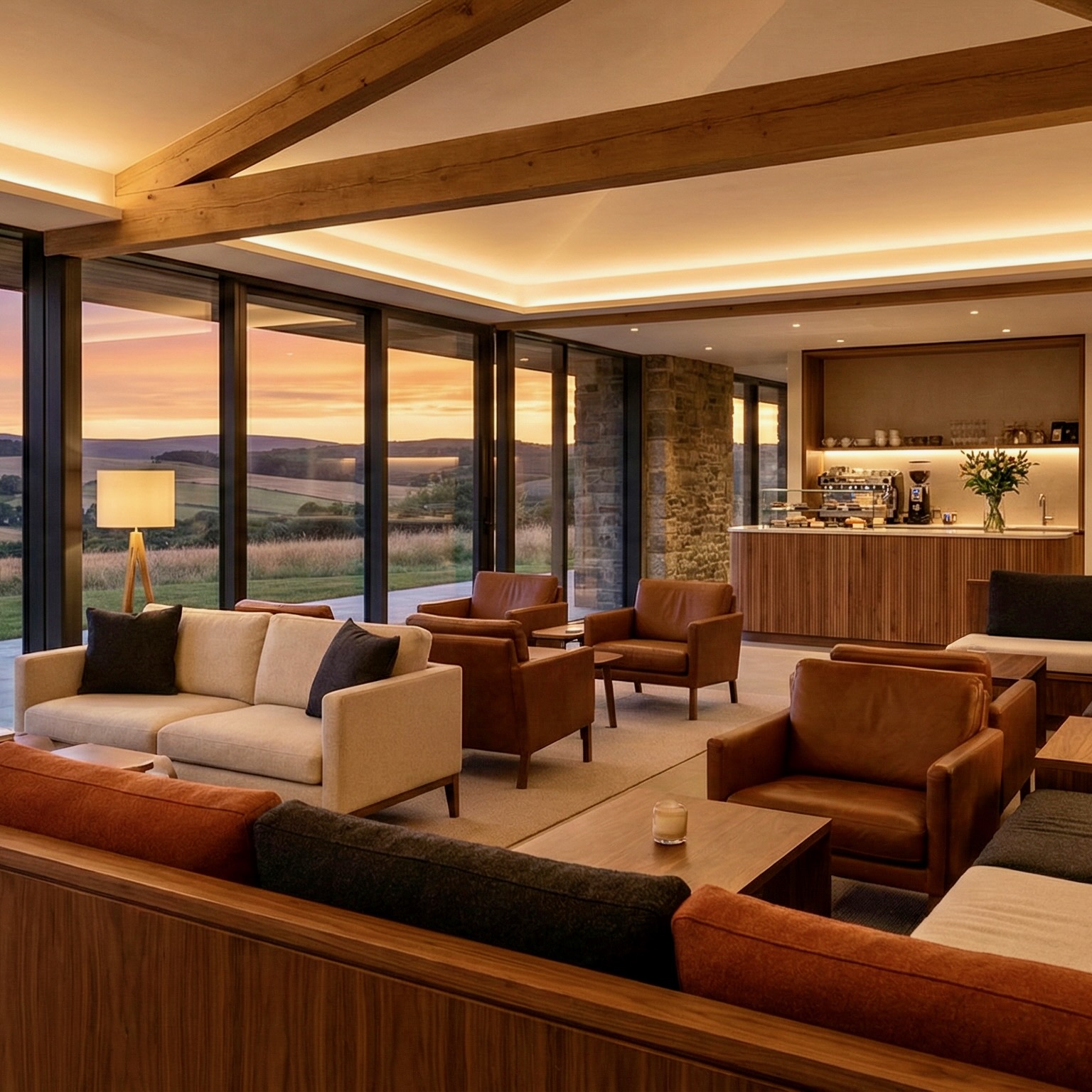
The clearest example is what we call our indoor comfort guarantee: a climate-controlled Driver’s Lounge at every single Rangeway location. Not at select premium sites. Not where partnerships allow. Everywhere, every time, no exceptions.
This might sound like a small thing until you’ve charged an EV in the Mojave Desert in August, or along a mountain pass in January, or anywhere during a dust storm or downpour. The industry standard today is standing outside next to your car, or sitting in your car with the climate running, or hoping there’s a nearby gas station with a passable restroom.
We think that’s a problem worth solving. So every Rangeway location, regardless of format, includes a climate-controlled indoor space with comfortable seating, premium restrooms, and high-speed Wi-Fi. You’re never stuck outside in bad weather. That’s not a luxury we offer at flagship locations. It’s a baseline standard we guarantee everywhere.
Two Formats, One Standard
We operate two location formats designed for different moments in your journey.
Basecamps are full-service destinations with 10-12 ultra-fast chargers and 2,500 or more square feet of climate-controlled lounge space. They include a staffed café with a curated menu. These are designed for the longer stop, the midpoint of a road trip, the place you might actually look forward to reaching.
Waystations are streamlined stops with 8-10 ultra-fast chargers and 800-1,000 square feet of lounge space. They feature automated retail rather than staffed service. These are designed for efficient corridor travel when you want comfort without an extended stay.
Here’s what matters: both formats deliver the same indoor comfort guarantee. The experience scales, but the standard doesn’t drop.
The Hospitality Background
This approach comes from somewhere. Our founder spent more than 15 years in hospitality operations at properties including Wynn Las Vegas, Cosmopolitan of Las Vegas, Grand Hyatt Nashville, and Sensei wellness retreats. That background shapes how we think about everything from restroom design to staff training to how we consider the time drivers spend in our spaces.
We think like hotel operators, not utility companies. That’s not a tagline. It’s a description of how decisions get made.
The Seamless Guest Experience
Hospitality isn’t just about the physical space. It’s about removing friction from the entire experience.
That’s why we partnered with Juice, a computer-vision identity and payments company, to power what we call plug-and-go charging. After a one-time vehicle registration, drivers can pull into any Rangeway location, plug in, and have charging start and bill automatically. No apps to open. No cards to tap. No QR codes to scan. You just plug in, step inside the Driver’s Lounge, and everything happens in the background.
This matters more than it might seem. At most charging stations today, you arrive, figure out which app or payment method works at this particular network, authenticate, start your session, monitor your phone for completion, then handle payment. It’s a series of small friction points that add up to an experience that feels transactional rather than hospitable.
We wanted to flip that. Our goal is to make technology feel like an invisible concierge: always working, never in the way. Arrive, plug in, relax. When you’re ready to leave, unplug and go. The charging, the payment, the loyalty credits, all of it handled automatically.
Over time, we’ll extend this same seamless experience to café purchases and retail. Your vehicle becomes your passport to the entire Rangeway experience: charging, lounge entry, food and beverage. One identity, recognized the moment you arrive, no cards or apps required.
Think of it like walking into a hotel where the staff already knows who you are. You don’t have to check in at every touchpoint. The experience just flows. That’s what we’re building for EV charging, and Juice’s visual identity technology makes it possible.
Strategic Focus vs. Ubiquity
One thing you’ll notice about Rangeway: we’re not trying to be everywhere.
This is intentional, not a limitation.
Our strategy is building a curated network where premium charging infrastructure doesn’t exist today. We’re focusing on the routes that long-distance travelers actually use, the communities that have been passed over by networks chasing urban density and high-traffic interstate corridors.
This focus allows us to do something important: guarantee consistency.
When you’re building 30,000 locations nationwide with multiple tiers, variability is almost unavoidable. A driver might eventually arrive at a flagship Beacon location with a lounge and restrooms (once they’re built), or they might arrive at a Relay site with a canopy and whatever amenities happen to be nearby. IONNA has stated that 70-80% of their network at scale will be their higher-tier formats, but their current deployments are weighted toward the basic Relay tier. The experience you get depends on which tier you happen to find along your route.
When you’re building a curated network with intention, you can control every variable. Site selection, design standards, operational quality, brand execution. Every Rangeway location reflects the same standards because we’re not stretching to be everywhere at once.
For the driver, this means something practical: you know what you’re getting before you arrive. No hoping this particular location has decent restrooms. No wondering if there’s anywhere to sit besides your car. No checking reviews to see if this stop is one of the good ones.
Quality and curation over ubiquity and compromise. That’s the tradeoff we’ve made, and we think it’s the right one for the drivers we serve.
What This Means for Drivers
Let’s get concrete about what this approach delivers.
Predictable Experience
Every Rangeway stop meets the same standard. Climate-controlled indoor space. Premium restrooms. Comfortable seating. High-speed Wi-Fi. At Basecamps, add a staffed café. At Waystations, add automated retail options. You can plan your trip knowing exactly what each stop will offer.
Pathfinder Rewards
Our loyalty program, Pathfinder Rewards, reflects the same philosophy. It’s free to join, and everyone pays the same base rate for charging. Status is earned through usage, not purchased. As you move up through tiers, from Explorer to Voyager to Pioneer to the invite-only Trailblazer level, you earn credits back toward future charging plus experiential perks like complimentary beverages at Basecamps, exclusive merch, and member events.
No time-of-use pricing complexity. No surge rates. No wondering what you’ll pay based on when you arrive. Predictability and transparency, because that’s what hospitality looks like.
While other networks are still developing their loyalty approaches, Pathfinder is designed to be live from day one.
Planning Made Easier
For the road trip driver, this changes how you think about charging stops. Instead of identifying the least-bad option along your route, you’re identifying the Rangeway locations and planning around them. The stop becomes part of the trip rather than an interruption to it.
That’s the experience we’re designing for.
Room for Everyone
Here’s something we believe strongly: EV adoption needs multiple approaches.
It needs urban convenience hubs where commuters can top up quickly near home or work. Rove is building that.
It needs nationwide coverage so drivers never worry about finding a charger on any highway in America. IONNA is building that.
It also needs premium hospitality in the places those approaches don’t reach: smaller towns, the routes between major metros where long-distance travelers find themselves with few good options. That’s what we’re building.
These aren’t competing visions. They’re complementary pieces of a larger puzzle. The same driver might use all three networks at different moments in their life: IONNA on an interstate road trip, Rove near their office, Rangeway on a leisurely drive through wine country or out to visit family three states away.
We’re not trying to replace anyone or prove anyone wrong. We’re serving a specific driver, on a specific kind of journey, with an experience designed specifically for that moment.
If you’re planning a road trip and want charging stops that feel like part of the journey rather than an interruption to it, we want to be there for you.
That’s what hospitality-first means to us.
Rangeway is building America’s first hospitality-driven premium EV charging network. Learn more about our approach at [website] or join Pathfinder Rewards to be notified when locations open.
Recent Posts
Infrastructure Isn't SaaS: What Nobody Tells Founders About Building Physical Things
I was listening to the most recent episode of The eMobility Marketing Podcast where Theo Reichgelt sat down with Philip Meyer of Lazy Growth Partners to talk about building B2B...
Read moreThe EV charging experience is getting better. We think that's not enough.
Credit where it’s due: the industry is waking up. Comfortable lounges. Clean restrooms. Better lighting. Real amenities. Some operators are doing genuinely good work making the charging stop more pleasant....
Read moreThe State of EV Charging in 2025: Quality Is Finally Winning
The numbers are in. Paren’s Q4 2025 State of the Industry Report confirms what the data has been showing for years: EV charging infrastructure is growing fast, but quality is...
Read more